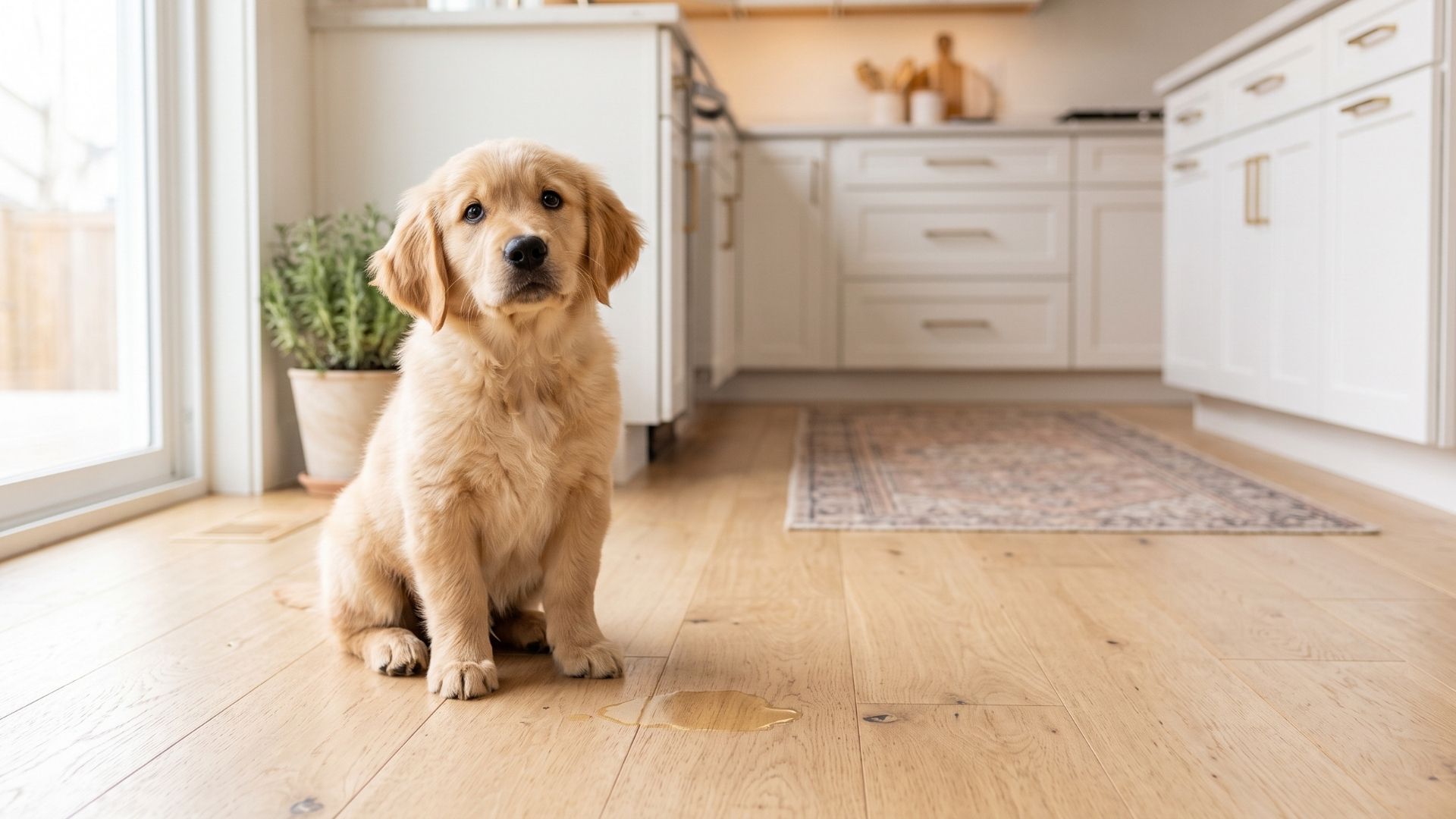
You’re doing everything right. You take your puppy out. You give treats. You’ve read the guides. And yet, there it is again: another puddle on the kitchen floor, five minutes after you came back inside.
It’s frustrating, and it can make you feel like your puppy just isn’t getting it. But puppy accidents almost always have a reason. Once you know why your puppy is going indoors, the fix is usually simple.
This guide works like a troubleshooter. Find the situation that sounds like your puppy, see what’s causing it, and follow the fix. You’ll also find the right way to clean up (most people get this wrong), a quick-reference table, and the signs that mean it’s time to see the vet.
Short on time? Our top 3 picks
- Must-have for every accident: An enzyme cleaner
- Best for finding hidden spots: A UV torch
- Best for a calmer, more focused puppy: Brain training games
First: Accidents Are Normal
Young puppies have small bladders and very little control over them. Their bodies simply aren’t ready to “hold it” like an adult dog. Many puppies are mostly reliable somewhere around 4 to 6 months old, but occasional accidents up to a year are common, and small breeds often take longer.
So an accident doesn’t mean you’ve failed. It’s information. It tells you something in the routine needs a small change.
If you haven’t set up a routine yet, start with our puppy potty training schedule, then come back here to fix any problems.
How To Clean Up A Puppy Accident Properly
Before we get into causes, this matters more than most people realise. Dogs are drawn back to places that smell like wee. If the smell is still there for your puppy’s nose, even if you can’t smell it, they’ll often go back to the same spot.
- Stay calm. No shouting, no fuss. Move your puppy to another room or their crate.
- Blot, don’t rub. Soak up as much as you can with kitchen paper. Rubbing pushes it deeper into carpets.
- Use an enzyme cleaner. These break down the compounds in urine that cause the smell. Spray generously and leave it for the time on the label.
- Skip ammonia-based cleaners. Urine contains ammonia, so these can smell like wee to a dog and actually attract them back.
- Let it dry fully. Keep your puppy away from the spot until it’s dry.
Our pick: Rocco & Roxie Supply Co. It breaks down the smell rather than covering it up, and it’s safe for most carpets, sofas, and hard floors.
Check The Price On AmazonIf your puppy keeps going in one area and you can’t see why, there may be old spots you’ve missed. A UV torch makes dried urine glow in the dark, so you can find and treat every one.
Our pick: Vansky UV Light Stain Detector. Turn the lights off, shine it across the floor, and old stains show up so you can clean them properly.
View On AmazonWhy Is My Puppy Having Accidents? 10 Common Problems And Fixes
1. “My Puppy Pees As Soon As We Come Back Inside”
Why it happens: Outside is exciting. Smells, birds, leaves. Your puppy gets so busy exploring that they forget to go, then the moment they’re back in the calm of the house, their body remembers.
The fix:
- Keep your puppy on a lead for potty breaks, even in the garden, and stand still in their potty spot.
- Be boring. No play, no chatting until they’ve been.
- Wait around 5 minutes. If nothing happens, go back in, keep them in their crate or right beside you, and try again in 10 to 15 minutes.
- Reward the second they finish, then let them play outside as a bonus.
2. “My Puppy Has Accidents When I’m Not Looking”
Why it happens: Too much freedom, too soon. A puppy wandering the house unsupervised will find a quiet corner, and once they’ve gone there, the smell invites them back.
The fix: Shrink your puppy’s world for now. Keep them in the same room as you, close doors, or use baby gates. When you can’t watch them, use a crate or playpen. Some owners clip the lead to their belt for a few days so the puppy is always right beside them. Give freedom back one room at a time, only after a couple of weeks without accidents.
3. “My Puppy Pees When I Come Home Or When Visitors Arrive”
Why it happens: This is often excitement urination or submissive urination, and it’s not a toilet training problem at all. Your puppy isn’t choosing to go. It’s an involuntary reaction to big emotions. Many puppies grow out of it as they mature and gain confidence.
The fix:
- Keep greetings low-key. Ignore your puppy for the first minute or two when you get home, until they’ve calmed down.
- Greet them outside where a little wee doesn’t matter.
- Crouch down side-on rather than leaning over them, and avoid direct staring.
- Ask visitors to do the same.
- Never tell your puppy off for this. It makes it worse.
4. “My Puppy Pees During Play”
Why it happens: Play gets things moving. Excitement and activity fill the bladder fast, and a young puppy won’t stop a fun game to ask.
The fix: Take a potty break every 10 to 15 minutes during play, and always straight after a play session ends. Shorter, calmer games help too. Our indoor puppy games guide has calmer ideas.
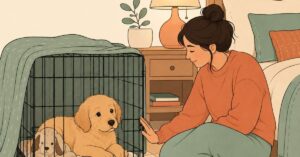
5. “My Puppy Pees In Their Crate”
Why it happens: Usually one of these:
- The crate is too big. There’s room to sleep at one end and wee at the other.
- They’re left too long. Longer than they can physically hold it.
- Bedding soaks it up. A puppy pad or thick absorbent bed can make wetting the crate feel normal.
- Background. Puppies raised in cramped, dirty conditions may have learned to go where they sleep.
- A medical problem. If the other causes don’t fit, check with your vet.
The fix: Use a divider so the crate is just big enough to stand, turn, and lie down. Shorten the time in the crate, and take your puppy out as soon as they wake. Remove puppy pads from the crate. See our puppy crate training guide for more.
6. “My Puppy Has Accidents At Night”
Why it happens: Young puppies often can’t make it through the whole night. A common rule of thumb is that a puppy can hold it for about one hour per month of age, plus one, and that’s when they’re asleep and resting.
The fix:
- Make the last potty break as late as you can.
- Pick up the water bowl an hour or two before bed, unless your vet advises otherwise or it’s very hot.
- Set an alarm for a night-time potty break, rather than waiting for your puppy to cry. Then slowly push it later over the coming weeks.
- Keep night breaks boring: low lights, no talking, no play, straight back to bed.
More help in our guide to why puppies cry at night.
7. “My Puppy Was Doing Great, Then Started Having Accidents Again”
Why it happens: Regression is very common. Often there’s a trigger: moving house, a new baby or pet, a change in routine, a stressful event, or getting more freedom too quickly. Sometimes there’s no obvious reason at all. It can also be a sign of a health problem, so if it’s sudden, see the warning box below.
The fix: Go back to basics for a week or two. Return to a tighter potty schedule, more supervision, and big rewards for going outside. Most puppies get back on track quickly.
8. “My Puppy Refuses To Go Outside In The Rain Or Cold”
Why it happens: Plenty of puppies hate getting wet, and some find wind, noise, or darkness scary.
The fix: Go out with your puppy every time, even if it means standing in the rain. Choose a spot close to the door, ideally under some cover. Keep treats in your pocket and reward fast so they can get back inside. Our winter puppy care guide has more tips for wet weather.
9. “My Puppy Lifts Their Leg On Furniture”
Why it happens: This is usually marking, not a full toilet accident. Marking tends to be small amounts on upright things, like table legs, curtains, or new objects. It often starts as puppies reach maturity, around 6 months or later, and can be more common in males that haven’t been neutered, though females mark too.
The fix: Clean every marked spot with an enzyme cleaner. Supervise closely, and interrupt calmly if you catch them starting, then take them outside. If it continues, talk to your vet about neutering and any other options.
10. “My Puppy Still Uses Puppy Pads, Even Though We’re Training Outside”
Why it happens: Puppy pads teach puppies that going indoors on something soft is fine. Some puppies then extend that to rugs, mats, and carpets.
The fix: If you need pads, keep them in one spot by the back door. Slowly move the pad closer to the door, then just outside, then stop using it. Keep taking your puppy outside on schedule the whole time. Washable pads are a less wasteful option while you transition.
Our pick: Sunheir. They’re reusable and machine washable, with a non-slip base, which makes them useful during the switch to outdoors.
See Sizes On AmazonPuppy Accident Quick-Fix Table
| Problem | Most likely cause | Quick fix |
|---|---|---|
| Pees right after coming inside | Distracted outside | Lead on, be boring, wait 5 minutes, reward on the spot |
| Accidents when you’re not watching | Too much freedom | Gates, crate, or playpen when unsupervised |
| Pees when greeting people | Excitement or submissive urination | Calm, low-key greetings, never punish |
| Pees during play | Full bladder from activity | Potty breaks every 10 to 15 minutes of play |
| Wets the crate | Crate too big, or left too long | Use a divider, shorten crate time |
| Accidents at night | Bladder too small yet | Later last break, set an alarm |
| Sudden return of accidents | Change, stress, or health | Back to basics, see your vet if sudden |
| Small wees on furniture | Marking | Enzyme cleaner, supervise, talk to your vet |
| Keeps going in the same spot | Lingering smell | Enzyme cleaner, check with a UV torch |
What Never To Do After An Accident
- Don’t punish or shout. Your puppy won’t link it to the wee. They’ll just learn that going in front of you is scary, so they’ll start hiding to do it.
- Don’t rub their nose in it. This old advice doesn’t work and damages your relationship.
- Don’t tell them off for something you found later. Even a minute later is too late for them to understand.
- Don’t give up on the routine. Consistency is what fixes accidents.
Caught them mid-wee? Calmly say “oops,” scoop them up or lead them outside, and reward them if they finish there. That’s it.
Help Your Puppy Tell You They Need To Go
Many accidents happen because your puppy needed to go and had no way to tell you. Teaching them to ring a bell by the door gives them a clear signal. Ring it yourself every time you take them out, and most puppies soon start ringing it themselves.
Our pick: PRODUCT_NAME_BELLS. They hang from the door handle and are easy for a puppy to nudge with their nose or paw.
Check Today’s PriceAlso learn your puppy’s own warning signs: sniffing the floor, circling, suddenly walking off during play, whining, or heading towards the door.
Deep Cleaning After Lots Of Accidents
If your carpets or rugs have taken a beating during potty training, an enzyme spray may not reach deep enough. A small spot cleaner machine lifts urine out of the fibres and makes a big difference to lingering smells.
Our pick: BISSELL. It’s compact, easy to grab when an accident happens, and pulls mess out of carpets and upholstery instead of just treating the surface.
See It On AmazonA Calmer Puppy Has Fewer Accidents 🧠🐶
Excitement and overstimulation play a big part in many accidents. Brain Training For Dogs is a step-by-step program of short games that build calm, focus, and self-control.
See The Brain Training Program- Suddenly starts having lots of accidents after doing well
- Wees very often, but only small amounts
- Strains, cries, or seems uncomfortable when weeing
- Has blood in their urine, or urine that smells unusually strong
- Is drinking much more than usual
- Dribbles urine while resting or asleep
- Has diarrhoea or frequent accidents with poo
Urinary infections and other health problems are fairly common in puppies and can look exactly like a training setback. Treating them often solves the “accidents” straight away.
Keep An Accident Log For A Week
If you can’t work out the pattern, write it down. For one week, note the time of every meal, drink, nap, potty break, and accident. Patterns usually appear quickly, such as accidents always happening 20 minutes after dinner or mid-afternoon after a long nap. Then adjust your schedule to get your puppy out just before those moments.
You’ll Get There
Every puppy has accidents, and every owner has stood over a puddle wondering what went wrong. Figure out the cause, clean up properly, adjust the routine, and stay patient.
Fewer puddles are usually just a few small changes away.
Build A Calm, Well-Mannered Puppy
Fun, structured training games you can do at home in just a few minutes a day.
Try Brain Training For DogsFrequently Asked Questions
Why does my puppy pee right after coming inside?
Usually because they were too distracted outside to go. Keep your puppy on a lead, stand still in one spot, stay boring, and wait around 5 minutes. If nothing happens, go back in, keep them close, and try again in 10 to 15 minutes.
What is the best way to clean up puppy accidents?
Blot up as much as you can, then use an enzyme cleaner, which breaks down the smell so your puppy isn’t drawn back to the same spot. Avoid ammonia-based cleaners, as they can smell like urine to dogs.
Is it normal for a potty trained puppy to have accidents?
Yes, occasional accidents and regression are common, especially after changes in routine or stress. Go back to a tighter schedule for a week or two. If accidents start suddenly or come with straining or blood, see your vet.
Should I punish my puppy for peeing inside?
No. Punishment teaches puppies to hide when they need to go, which makes training harder. Calmly take them outside if you catch them in the act, clean up with an enzyme cleaner, and reward them for going in the right place.