
TL;DR (For the Sleep-Deprived Reader)
- Most puppies crying in the crate at night settle down within 3 to 10 nights. A smaller number take up to two weeks.
- If the crying escalates past 10 to 15 minutes, or you hear panic signs (frantic panting, clawing, non-stop screaming), intervene. Do not let a puppy scream for hours.
- Keep the crate in your bedroom for the first 2 to 3 weeks. Your breathing and your smell do more calming work than any product on the market.
- Use the bladder rule: take your puppy’s age in months, add one, and that’s roughly the maximum hours they can hold it overnight.
- Before you do anything at 2 AM, figure out if the crying means panic, potty, or attention. Each one gets a different response.
If you only have three minutes and a half-asleep brain, that’s the whole article. If you want the details (and the exact 2 AM decision tree), keep reading.
Why Do Puppies Cry in the Crate Mostly at Night? (The Real Reasons)
Puppy crying in crate at night is one of the most common reasons new owners end up scrolling their phones at 3 AM looking for answers. The good news is that it’s almost always explainable, and usually temporary. Let’s go through the real reasons, one at a time, so you can figure out which one applies to your puppy tonight.
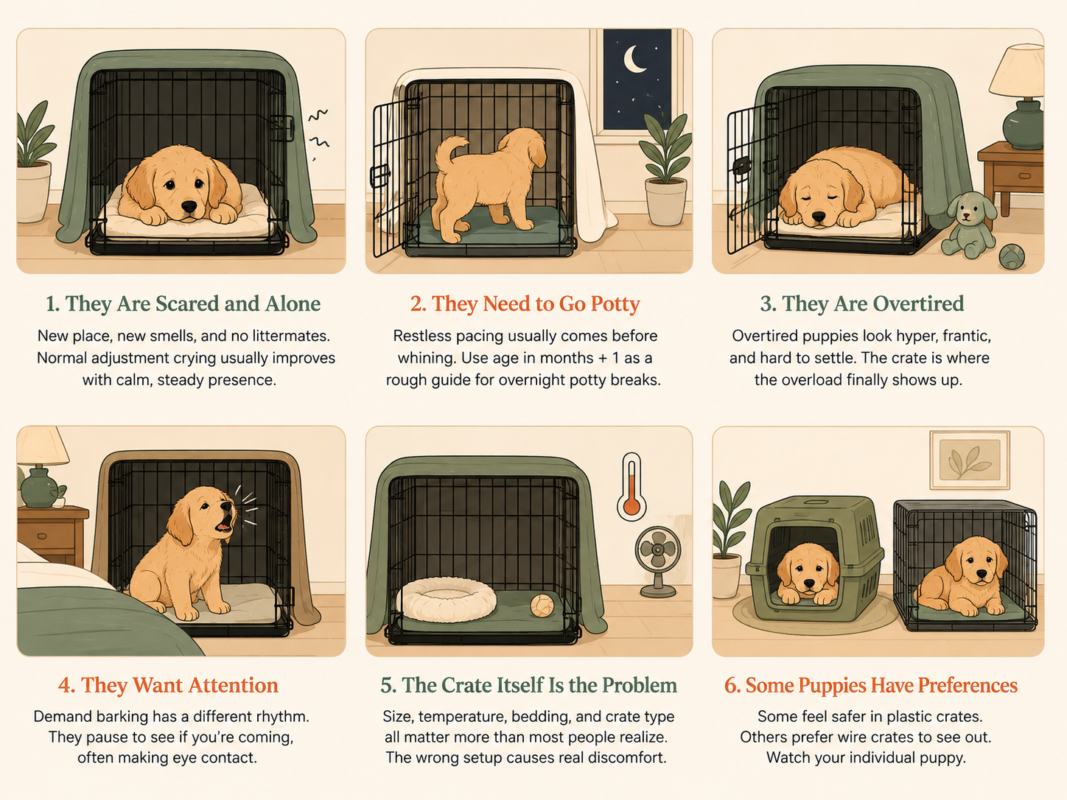
They Are Scared and Alone
This is usually the reality of night one. Your puppy was just separated from their littermates and mother, often for the first time in their life. Everything around them smells wrong. The house is unfamiliar. The crate, which will eventually feel like a safe den, currently feels more like a trap.
Normal adjustment crying tends to be rhythmic. It rises and falls, and it usually tapers off when you offer calm, steady presence nearby. This isn’t a training failure on your part. It’s a nervous system adjusting to an enormous change in one day.
They Need to Go Potty
A lot of what looks like “puppy whining in crate at night” is actually a bathroom request. Use this simple guideline: take your puppy’s age in months and add one. That number is roughly how many hours they can comfortably hold their bladder overnight. A 2-month-old puppy can typically hold it for about 3 hours. A 3-month-old can usually manage about 4 hours.
Small breeds often need more frequent breaks than large breeds, even at the same age. Don’t expect a teacup Yorkie to hold it as long as a Labrador puppy. Their bladders are simply smaller, and their metabolism runs faster.
Here’s how to tell if the crying is potty-related: the puppy will usually get restless and pace around the crate before they start vocalizing. If you notice movement first, then whining, that’s typically a potty signal, not panic.
They Are Overtired
This one surprises a lot of new owners. Puppies don’t regulate their own sleep the way adult dogs do. An overtired puppy doesn’t get sleepy and quiet. Instead, they often look hyper, frantic, and almost impossible to settle.
This is one of the most overlooked causes of crate crying at night. The puppy isn’t being difficult on purpose. Their nervous system is overloaded, and the crate is where that overload finally surfaces.
They Want Attention
Demand barking has a different rhythm than panic crying. A puppy seeking attention will often pause to check if you’re coming. You might even catch them making eye contact through the crate bars, watching for a reaction.
If the crying stops the second you walk into the room and starts right back up when you leave, that’s usually attention-seeking rather than distress.
The Crate Itself Is the Problem
Sometimes the issue isn’t emotional at all. It’s physical setup.
A crate that’s too big lets your puppy potty in one corner and sleep in another, which undermines the entire point of the crate. Too small, and they can’t stand up, turn around, or lie down comfortably, which will absolutely cause distress-based crying.
Temperature matters more than people expect. Overheating is a common hidden cause of nighttime restlessness. If your puppy is a heavy chewer, skip the thick, fluffy bed (which can also be a choking hazard if pieces get torn off) and use a flat crate mat instead.
Some puppies feel safer in an enclosed plastic crate because it feels more den-like. Others feel trapped in plastic and settle better in a wire crate where they can see out. There’s no universal right answer here. Watch your individual puppy.
Normal Adjustment vs. Confinement Anxiety vs. Separation Anxiety
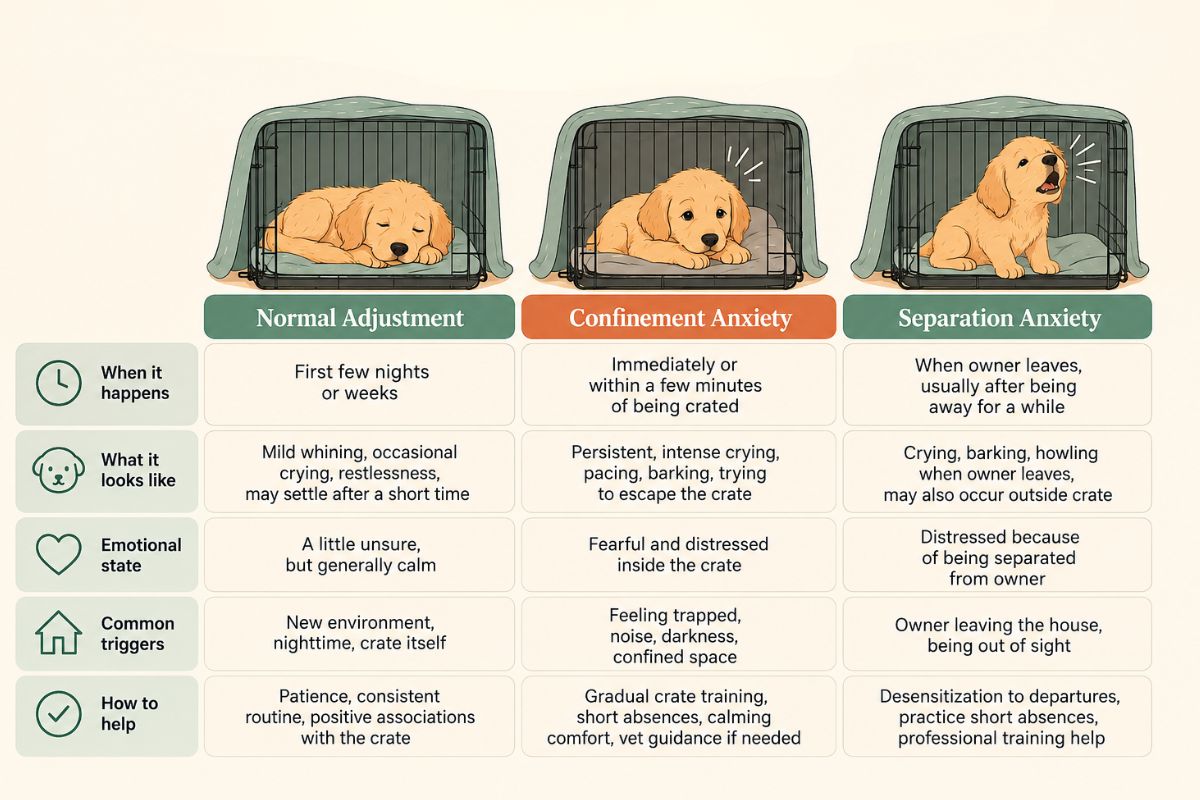
This is the section most articles skip, and it’s arguably the most important one for figuring out what to actually do about your puppy crate anxiety at night. Confusing these three categories leads owners to either give up on the crate too soon, or push through something that sincerely needs a different approach.
Normal Adjustment Crying
This is what most puppies experience. The signs: it happens mainly during the first 3 to 10 nights, it steadily improves night over night, and it responds to calm comfort. Your puppy might whine for a few minutes after being placed in the crate, then settle in on their own. This is typical, expected, and not a reason to panic.
Confinement Anxiety
This one gets missed constantly, and it’s really different from ordinary whining. A puppy with confinement anxiety panics specifically when confined. If they’re loose in the room and you leave, they’re fine. Put them behind a barrier or in a crate, and the panic kicks in immediately.
Watch for these signs: attempts to break out of the crate, digging or biting at the bars, bloody paws, broken or chipped teeth, excessive drooling, and visible shaking.
If you see any signs of self-injury, stop using the crate immediately. Switch to a puppy playpen or a tether setup temporarily, and work on rebuilding a positive crate association gradually, during the day, when stakes are lower and you can supervise closely.
True Separation Anxiety
This is a different condition entirely, and it’s less common than people assume. The signs here show up even when the puppy isn’t confined. They follow you from room to room, obsessively. They become destructive when left alone in any space, crate or no crate.
If you suspect true separation anxiety, consult a board-certified veterinary behaviorist or a certified applied animal behaviorist. This is beyond basic crate training. The American Veterinary Society of Animal Behavior notes that many dogs with separation anxiety actually have confinement anxiety layered on top of it, which is exactly why the two get confused so often, and why an accurate diagnosis from a professional matters more than guessing at home.
What to Expect Night by Night
One of the most common questions new owners ask is simply “how long does puppy crying at night last?” Here’s a realistic timeline based on what typically happens with healthy puppies going through normal adjustment.
Night 1: The Hardest Night
Expect crying on and off throughout the night. Your puppy is exhausted, but also completely disoriented. This is the night most owners describe as brutal, and honestly, it usually is.
Your action plan: keep the crate in your bedroom, within arm’s reach. Let your puppy smell you. If needed, you can rest your fingers through the crate bars for physical contact. Keep your talking to a minimum. Calm, boring presence works better than reassurance out loud.
Night 2: Slightly Better
Most puppies cry for roughly half the duration compared to night one. This is usually when owners start to feel a flicker of hope, and that hope is generally justified.
Night 3: Just a Few Hours
By night three, crying typically drops down to just a few hours, and it’s often concentrated at the very beginning of the night rather than scattered throughout.
Night 4 and Beyond: The Turning Point
The average puppy is sleeping quietly through the night by night four. If you’re not seeing meaningful improvement by night 7 to 10, it’s worth reassessing your entire approach: crate size, location, bedtime routine, and potty schedule.
The Week 2 Regression
Here’s something almost nobody warns you about. Some puppies do great for a week or two, then suddenly start crying again out of nowhere. This is not a failure on your part. It often actually means something positive: your puppy has bonded with you enough to protest your absence.
If this happens, go back to basics. Revisit your bedtime routine, double-check the crate’s location, and make sure comfort items are still in place. This kind of regression is common during the early weeks and usually resolves faster than the first round did.
The Exact Bedtime Routine That Works
“Tire them out before bed” is advice everyone gives and almost nobody explains properly. Here’s a real crate training puppy night routine with actual timing.
2 Hours Before Bed
Offer the last water intake. Don’t restrict water all day thinking it’ll help nighttime dryness. That approach causes dehydration and doesn’t actually reduce accidents. Just keep an eye on intake during this final window.
Keep your puppy awake during this stretch. Skip long naps here. A puppy who has finally awake and active in the two hours before bed will sleep deeper once you do put them down.
30 to 45 Minutes Before Bed
Give your puppy a physical outlet, but skip the wild chase games that overstimulate rather than tire out. Gentle tug or a slow game of fetch works well.
Add in some mental work too: 10 to 15 minutes of basic training using their dinner kibble as rewards. Sit, down, touch, and place commands burn mental energy fast, often faster than physical exercise does.
Take them on a sniffy potty walk. Let them sniff as much as they want. Sniffing is a calming systems for dogs at a neurological level, and it tends to lower heart rate before bed.
10 Minutes Before Bed
This window is for calm decompression only. Offer a safe chew toy or a frozen stuffed Kong.
Dim the lights. Lower your own energy and volume. No loud voices, no excited last-minute play.
Crate Entry Protocol
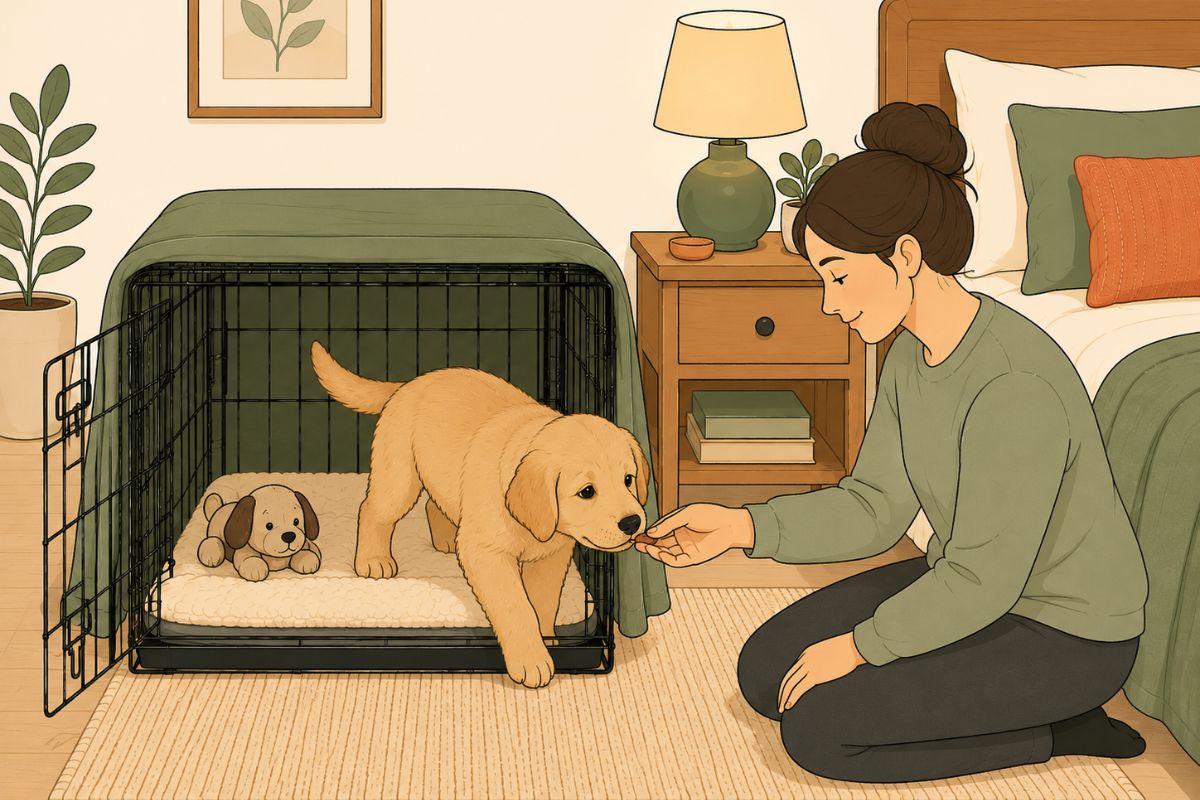
Use one consistent cue word every single time, like “kennel” or “crate.” Toss a high-value treat inside as they go in.
Wait until your puppy is calm before closing the door. If they’re frantic the moment the door closes, they’ll start associating the crate itself with panic, which makes future nights harder, not easier.
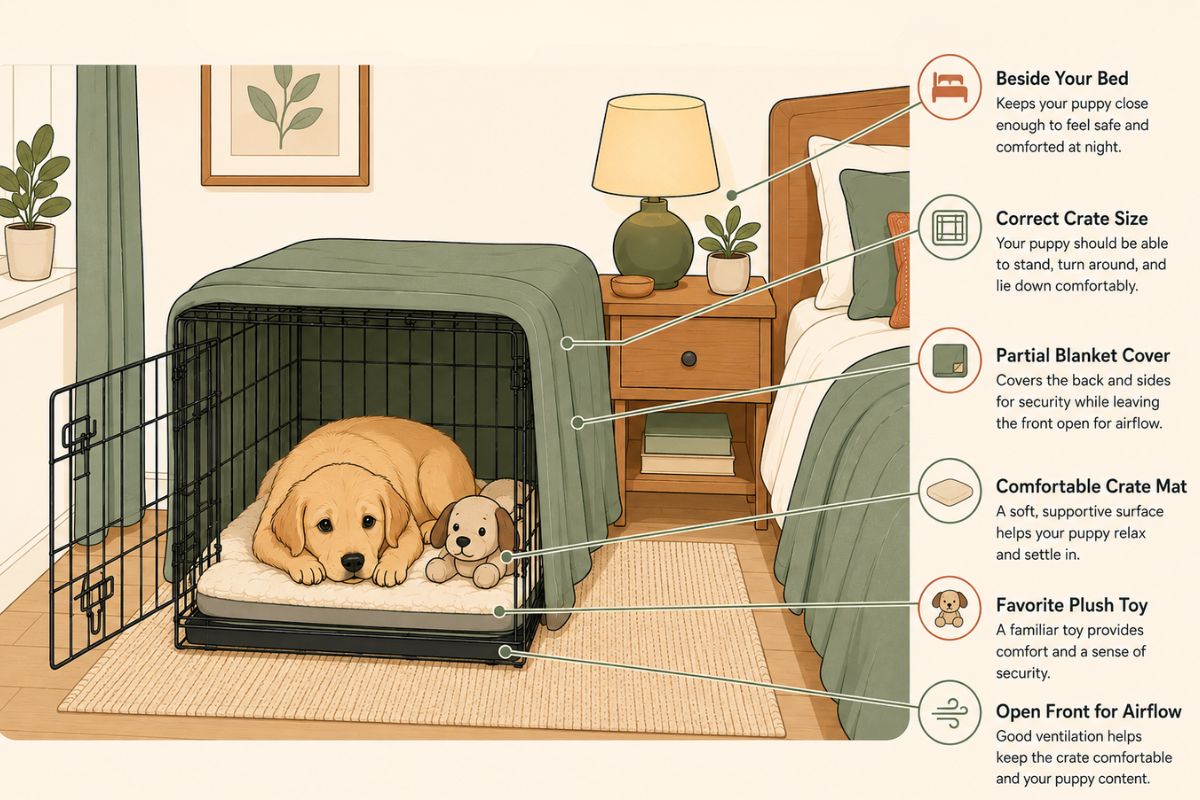
A lightweight blanket over the crate can create a den-like feel that helps some puppies settle. That said, monitor your individual puppy. Some prefer an open view and settle better without a cover at all.
What to Do When Your Puppy Cries at 2 AM (The Decision Tree)
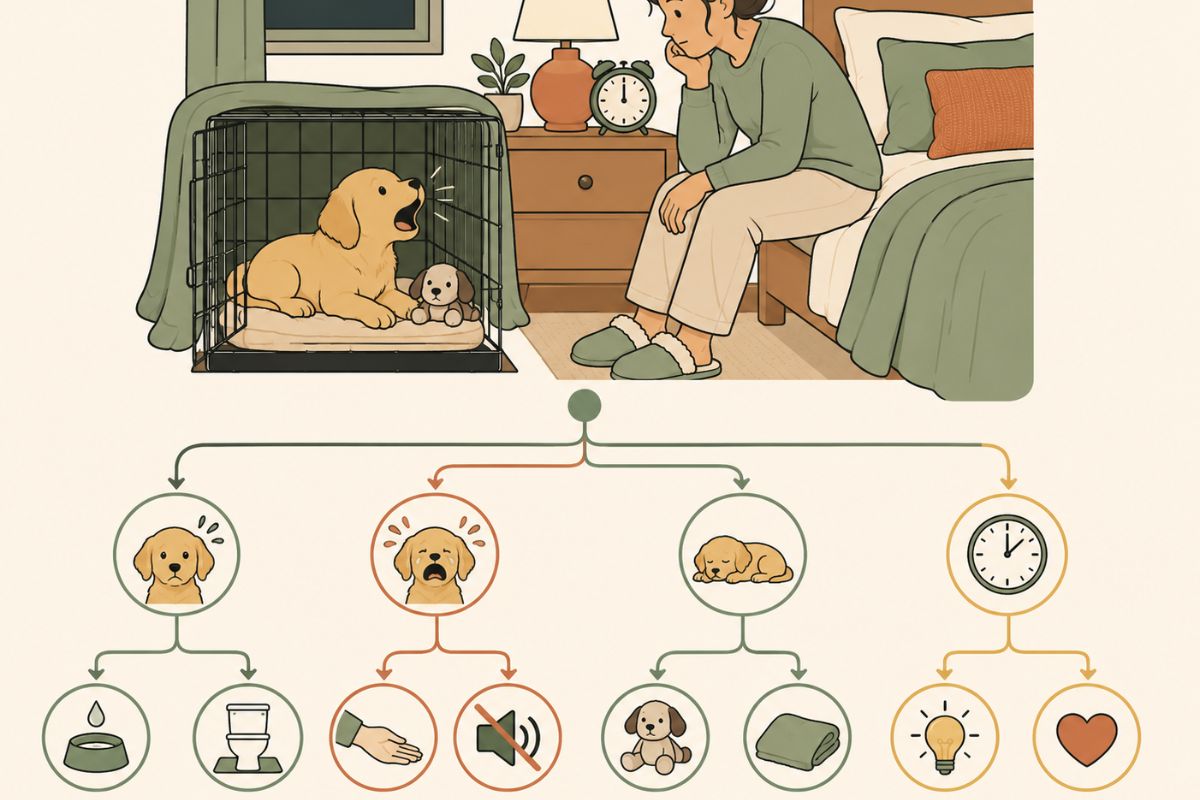
This is the part most articles skip entirely, and it’s the part you actually need at 2 AM. Here’s exactly how to think through it, step by step.
Step 1: Pause and Listen for 30 to 60 Seconds
Is the crying escalating or tapering off? Escalating means you should intervene. Tapering means it’s usually best to wait it out.
Two to three minutes of what trainers call “contact calling” is normal. Give your puppy a genuine chance to self-settle before you act.
Step 2: Identify the Type of Cry
High-pitched, frantic, non-stop crying paired with panting, pacing, or clawing usually means panic or physical discomfort. Comfort your puppy without removing them from the crate.
Rhythmic crying that pauses (like they’re checking whether you’re coming) usually means attention-seeking. Wait for a lull of 5 to 10 seconds of quiet before you respond or open the door.
Restless movement around the crate first, followed by whining, usually means a potty need. Take them out quietly and without fanfare.
Step 3: The Intervention Ladder
Work through these in order, only moving to the next step if the previous one doesn’t help:
- Verbal reassurance from your own bed. Something simple like “Shh, you’re okay” in a low, steady tone.
- Rest your fingers through the crate bars for physical contact.
- Sit on the floor next to the crate with your back to it. Your presence alone, without direct engagement, is often enough to settle a puppy.
- If panic continues, open the crate, pet your puppy while they’re still inside, then re-close the door.
- If your puppy is still panicking after 10 to 15 minutes, consider setting up a temporary playpen for the rest of the night. Safety comes before training every time.
Step 4: The Potty Break Protocol
Carry your puppy to the potty spot to avoid an accident along the way.
Pre-position your shoes, coat, leash, and treats somewhere easy to grab before bed, so you’re not fumbling around in the dark half-asleep.
Keep the whole break boring on purpose. No talking, no lights beyond what you need to see, no play. Straight to the spot, straight back to the crate.
Wait for 5 to 10 seconds of quiet before opening the door to go out, and again before opening it to come back in. This small habit teaches your puppy that calm gets the door open, not crying.
Setting Up the Crate for Success
Location: Bedroom First
Keep the crate in your bedroom for the first 2 to 3 weeks. Your breathing and your scent nearby do more to calm a puppy than most products claim to.
Once your puppy is reliably sleeping through the night, try the “walking bed” technique: move the crate about one foot per day toward its eventual location. Sudden moves tend to trigger regression, so gradual is
6 worth the extra few days.
Size and Type
The crate should be just large enough for your puppy to stand up fully, turn around, and lie down completely stretched out. Not a playroom, just enough space to be comfortable.
A divider panel is worth the investment for growing puppies. It lets you adjust the usable space as they grow, so you’re not buying multiple crates over the first year.
Comfort Items That Actually Work
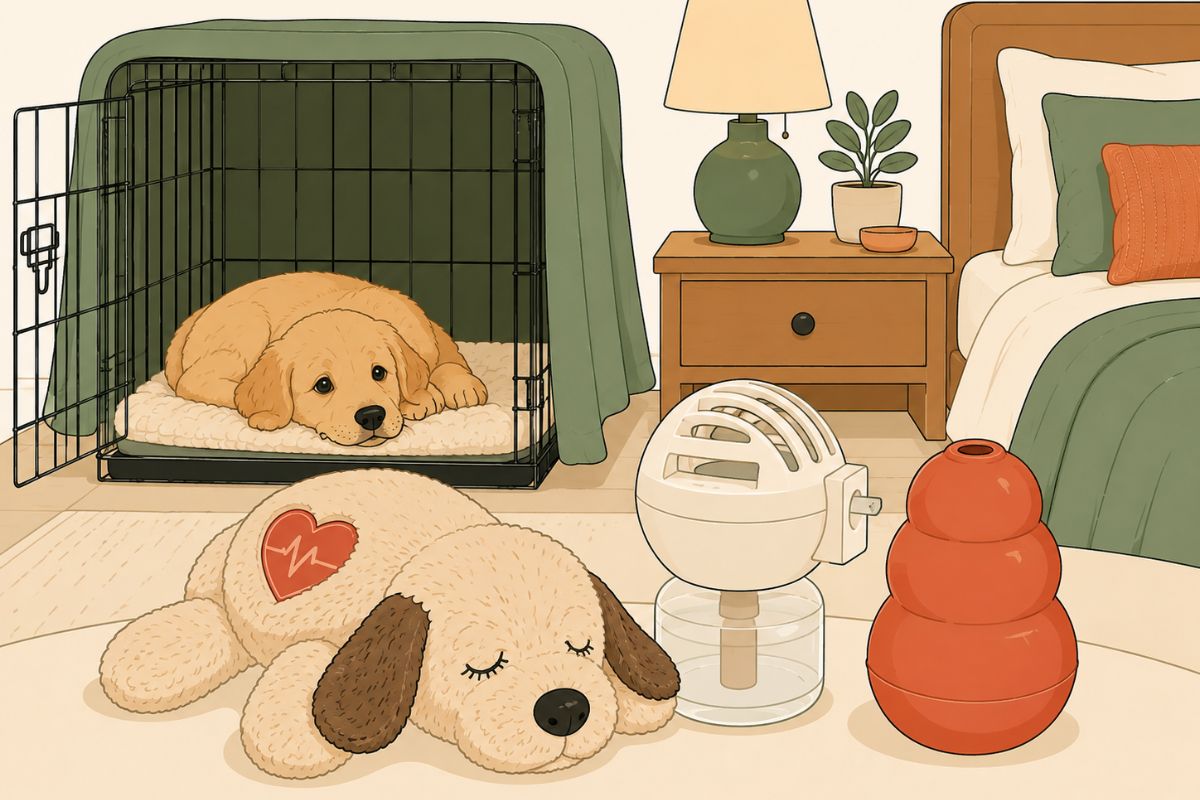
- Snuggle Puppy or a heartbeat toy: many owners report real success with this, especially for puppies between 8 and 12 weeks old. It’s not a magic fix on its own, but it works well paired with proper training.
- Pheromone diffusers like Adaptil or ThunderEase: place these near the crate, not inside it.
- Your worn t-shirt: skip anything with strings, hoodie ties, or loose fabric that could be chewed off and swallowed.
- A safe chew toy or a frozen stuffed Kong.
- White noise machine or soft classical music: gentle background sound helps mask household noises that might otherwise startle your puppy awake.
The “Cry It Out” Debate: What Experts Actually Say
Should you let your puppy cry it out? This is honestly one of the most searched, most argued-about questions in crate training, and the honest answer sits somewhere in the middle.
The Case for Brief Waiting
It’s okay to let your puppy cry for a few minutes to give them a real chance to settle on their own. Waiting for a lull of 5 to 10 seconds before opening the crate teaches them that quiet, not noise, gets results.
The Case Against Extended Crying
Fear-free certified trainers are consistent on this point: comforting a sincere panicked puppy is not reinforcing bad behavior. Panic is not manipulation, and treating it like manipulation can make things worse.
Stressful events experienced early in a puppy’s life can affect how well they cope with stress later on. Letting a puppy scream for hours isn’t training. It’s flooding, and it can do more harm than good.
If crying goes past 10 to 15 minutes and keeps escalating, that’s your signal to step in.
The Balanced Approach
Ignore mild whining. Intervene for genuine panic. It’s completely okay to comfort your puppy. What matters is how you do it: keep it boring, calm, and brief, and avoid removing them from the crate unless there’s an actual safety concern.
Special Situations
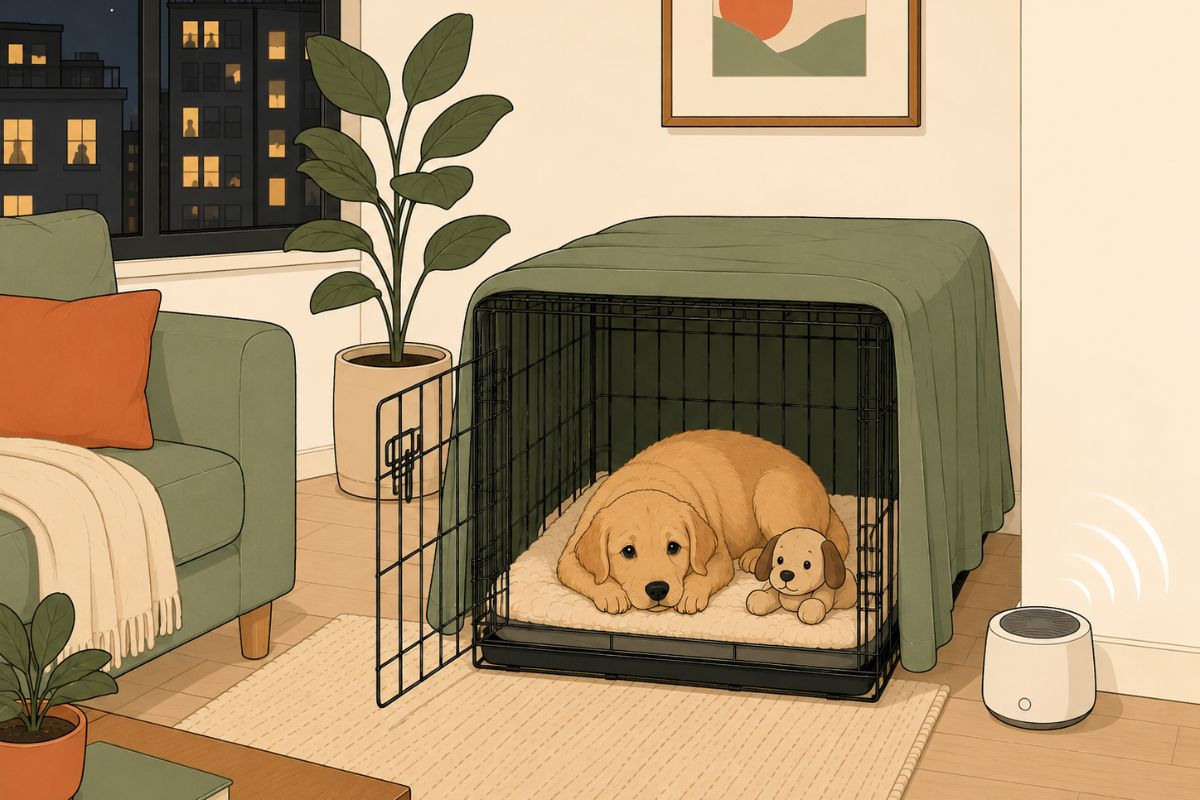
Apartment Living and Thin Walls
Talk to your neighbors before you even bring the puppy home if you can. Explain that crate training usually involves a few nights of crying and give them a rough timeline so it doesn’t feel indefinite.
Point a white noise machine toward shared walls specifically, not just anywhere in the room.
Do the most intensive stretch of crate training on weekends when you can nap during the day to make up for lost sleep.
A playpen is often quieter than a crate simply because the puppy feels less trapped inside it. Use one as a temporary bridge if neighbor complaints are a genuine risk in your building.
Small Breed Puppies
Smaller bladders mean more frequent potty breaks are needed, even beyond what the age-based bladder rule suggests.
Small breeds also tend to be more vocal and more sensitive to temperature changes than larger breeds. Adjust your overnight expectations accordingly rather than comparing notes with a friend who has a large-breed puppy.
When Partners Disagree
One partner wants the puppy in bed. The other wants strict crate training. This is an extremely common source of tension in the first few weeks, and you’re not the only household dealing with it.
A workable compromise: bedside crate for the first two weeks, then a gradual transition to wherever you’ve agreed the puppy will ultimately sleep. Or alternate schedules, crate on weeknights and supervised bed time on weekends, until you’re both on the same page.
Shift Workers
If your schedule rotates, consistency in the routine matters more than the exact clock time. Keep your puppy’s bedtime sequence identical (same steps, same order) even when the actual hour shifts from week to week.
When to Worry and Call a Professional
Most puppy crying in crate at night resolves on its own within the timeline above. But a few signs mean it’s time to bring in outside help rather than push through alone:
- Crying that continues past two weeks with no real improvement.
- Any sign of self-injury in the crate: bloody paws, broken teeth, damaged gums.
- Excessive drooling, shaking, or loss of appetite tied specifically to crate time.
- A sudden regression after months of prior success.
- Panic that only shows up when confined, but not when loose. That’s confinement anxiety, and a professional trainer can help.
- Panic that shows up even when your puppy isn’t confined at all. That’s more likely separation anxiety, and it calls for a board-certified veterinary behaviorist.
FAQ
How long should I let my puppy cry in the crate at night?
A few minutes of mild whining is fine and often resolves on its own. If it escalates past 10 to 15 minutes or shows signs of real panic, step in. Don’t let a puppy scream for hours.
Should I put a blanket over my puppy’s crate at night?
For most puppies, yes. It creates a den-like environment that feels safer. That said, watch your own puppy’s reaction. Some prefer to see out and settle better with the crate left uncovered.
Is it okay to let my puppy sleep in my bed instead?
In the short term, yes, if you’re desperate and it’s the difference between both of you getting real sleep versus none at all. Use a waterproof cover if you go this route. Long term, it’s usually better to wait until your puppy is potty trained and comfortable in the crate before making bed sleeping a permanent arrangement.
Why was my puppy fine in the crate and now crying again?
This is often adolescent regression, a routine change, or a sign your puppy has bonded with you enough to protest your absence. Go back to basics: bedroom crate location, consistent bedtime routine, and familiar comfort items.
Does the Snuggle Puppy actually work?
Many owners report genuine success with it, especially during the 8 to 12 week window. It’s not a replacement for training, but it works well as a supporting tool alongside a solid routine.
My puppy cries in the crate but is fine in a playpen. What’s wrong?
This points to confinement anxiety rather than separation anxiety. Your puppy is fine being away from you, as long as they’re not trapped in a small enclosed space. Use the playpen for now, and work on building a positive crate association gradually during the day.
You will get through this, and in a few weeks it will become like a distant memory.