
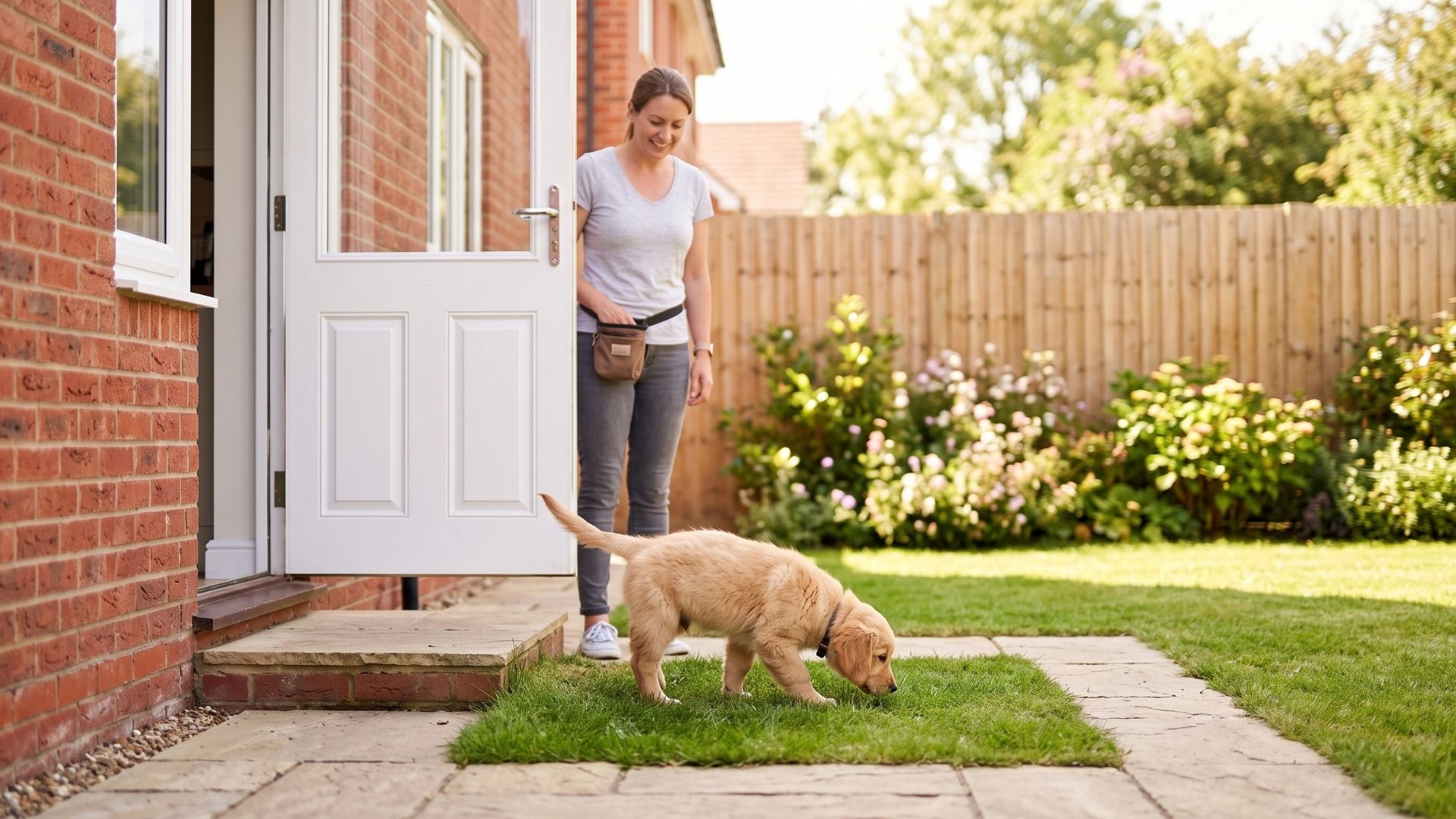
You’ve been outside for ten minutes. Your puppy has sniffed every blade of grass, chased a leaf, and eaten something you’d rather not think about. So you give up and go back inside.
Thirty seconds later, there’s a puddle on the kitchen floor.
Every new puppy owner has been there. The good news is that potty training isn’t about luck or having a “clever” puppy. It’s mostly about timing. Puppies need to go at very predictable moments, and once you know what they are, you can get your puppy outside before the accident happens instead of after.
That’s what a puppy potty training schedule does. Below you’ll find how long puppies can hold it at each age, a sample schedule for a full day, the exact steps to follow, and what to do when things go wrong.
Short on time? Our top 3 potty training picks
- Must-have for accidents: An enzyme cleaner
- Best for nights: A crate with a divider panel
- Best for a calmer, more focused puppy: Brain training games
When Do Puppies Need To Go Potty?
Puppies have small bladders and very little control over them. But they do follow a pattern. Most puppies need to go:
- As soon as they wake up, in the morning and after every nap
- Within 15 to 30 minutes of eating
- Shortly after drinking
- During or right after play, as excitement gets things moving
- After training or anything exciting, like visitors arriving
- Last thing before bed
On top of those moments, young puppies also need regular trips outside while they’re awake, even if nothing has happened. That’s where the schedule comes in.
How Long Can A Puppy Hold It?
A common rule of thumb is that a puppy can hold their bladder for about one hour for every month of age, plus one. So a 2 month old puppy can usually manage around 3 hours, and a 4 month old around 5 hours.
But that’s the maximum when they’re resting or asleep, not a target. While your puppy is awake and active, they’ll need to go much more often. Every puppy is different too, and small breeds often need more frequent breaks than large ones.
Puppy Potty Training Schedule By Age
Use this table as a starting point, then adjust it to fit your puppy:
| Age | Daytime potty breaks (while awake) | Night-time breaks |
|---|---|---|
| 8 to 10 weeks | Every 30 to 60 minutes, plus after eating, drinking, play, and naps | Usually 1 or 2 |
| 10 to 12 weeks | Every 1 to 2 hours, plus the key moments | Usually 1 |
| 3 to 4 months | Every 2 to 3 hours, plus the key moments | 0 to 1 |
| 4 to 6 months | Every 3 to 4 hours, plus the key moments | Usually none |
| 6 months and over | Every 4 to 6 hours | None |
Still seeing accidents? Shorten the gaps. It’s much easier to take your puppy out too often than to clean up after taking them out too little.
Sample Puppy Potty Training Schedule (8 To 12 Weeks)
Here’s what a full day might look like for a young puppy. Your times will be different, but the pattern is what matters: out after every wake-up, every meal, and every play session, with naps in between.
| Time | What happens |
|---|---|
| 6:30am | Wake up. Carry or walk your puppy straight outside. No stopping to make coffee first. |
| 7:00am | Breakfast and a drink |
| 7:20am | Potty break |
| 7:30am | Play and a short training session |
| 8:00am | Potty break, then nap in the crate or playpen |
| 10:00am | Wake up, straight outside for a potty break |
| 10:15am | Play, chew time, or socialisation |
| 11:00am | Potty break, then nap |
| 12:30pm | Wake up, potty break, then lunch |
| 12:50pm | Potty break, then quiet play |
| 1:30pm | Potty break, then nap |
| 3:30pm | Wake up, potty break, play and training |
| 4:30pm | Potty break, then chew time or a nap |
| 5:30pm | Dinner, followed by a potty break around 5:50pm |
| 6:00pm to 9:00pm | Family time with potty breaks every 30 to 60 minutes and after any play |
| 9:00pm | Take water up, unless your vet advises otherwise |
| 10:30pm | Final potty break, then bed in the crate |
| Around 2:00am | Night potty break (very young puppies may need another around 5:00am) |
How To Potty Train A Puppy: Step By Step
1. Pick One Potty Spot
Choose a spot outside, close to the door, and take your puppy there every time. The smells left behind tell your puppy “this is the place,” which makes going there faster and easier.
2. Go Outside With Your Puppy
Don’t just open the back door and wait. If you’re not there, you can’t reward them, and many puppies will sit by the door, wait to be let back in, and then go on the carpet. Put your shoes on and go out with them, even in the rain.
3. Use A Cue Word
As your puppy starts to go, calmly say a cue like “go potty” or “be quick.” Over time, they’ll link the word to the action, which is really handy later on when you need them to go before a car journey or bedtime.
4. Reward Straight Away
The moment your puppy finishes, praise them and give a tasty treat, right there on the spot. Not when you get back inside. Timing matters: the reward needs to come within a couple of seconds so your puppy knows exactly what earned it.
Our pick: Heouvo 1.67 Cup Magnetic Dog Treat Pouch. Clip it on before every potty trip so the reward is always ready the second your puppy finishes.
Check The Price On Amazon5. Supervise Indoors, Or Use A Crate Or Playpen
Most accidents happen when no one is watching. While your puppy is loose in the house, keep your eyes on them. When you can’t watch, use a crate or playpen. Most puppies try not to soil their sleeping area, so a crate helps them learn to hold it for short periods.
Make sure the crate isn’t too big. If there’s room for a bed at one end and a toilet at the other, your puppy may use it that way. A divider panel lets you make it smaller now and bigger as your puppy grows. See our puppy crate training guide to get started.
Our pick: MidWest Homes for Pets iCrate Single Door. It comes with a divider panel, so you can adjust the space as your puppy grows instead of buying a second crate.
See Sizes On AmazonOur pick: Amazon Basics Portable Foldable Octagonal Metal Exercise Dog Playpen. It gives your puppy a safe area with room to play, while keeping them off the carpets when you can’t watch them.
View On Amazon6. Give Freedom Slowly
A puppy who goes a week without accidents in the kitchen isn’t ready for the whole house yet. Add one room at a time, and only while you’re supervising. Too much freedom too soon is one of the most common reasons potty training goes backwards.
7. Teach Your Puppy To Tell You
Some owners hang a bell by the back door and ring it every time they take the puppy out. Many puppies soon start ringing it themselves when they need to go. It’s not essential, but it helps, especially if you can’t always see your puppy wandering towards the door.
Our pick: BLUETREE 2 Pack Dog Doorbells . They hang from the door handle and are easy for a puppy to nudge with their nose or paw.
Check Today’s PriceSigns Your Puppy Needs To Go
Learn to spot these, and take your puppy straight out the moment you see one:
- Sniffing the floor with their nose down
- Circling or turning on the spot
- Suddenly walking off in the middle of play
- Whining, or going to the door
- Squatting (time to move fast)
What To Do When Your Puppy Has An Accident
Accidents will happen. They’re part of the process, not a sign you’re failing.
- If you catch them in the act: calmly interrupt with a gentle “oops,” pick them up or lead them outside, and reward them if they finish there.
- If you find it afterwards: just clean it up. Your puppy won’t link a telling-off to something they did even a minute ago.
- Never punish. Shouting or rubbing their nose in it doesn’t teach your puppy where to go. It only teaches them to be scared of going in front of you, so they start hiding to do it.
- Use an enzyme cleaner. Normal cleaners may remove the smell for you but not for your puppy, and a lingering smell can draw them back to the same spot.
Our pick: Rocco & Roxie Supply Co. Stain & Strong Odor Eliminator. It breaks down the smell completely, so your puppy isn’t drawn back to the same spot. It’s safe for most carpets and floors.
See It On AmazonShould You Use Puppy Pads?
Puppy pads can be useful if you live in a flat high up, work long hours, or have a very young puppy who can’t hold it overnight yet. But they can also slow down outdoor training, because they teach your puppy that going indoors is okay.
If you use them, keep them in one spot near the door. Then slowly move the pad closer to the door, then outside, before stopping them altogether. And keep taking your puppy outside on schedule, even while pads are down.
Our pick: Amazon Basics Leak-Proof Dog and Puppy Potty Training Pee Pads. They’re extra absorbent with a leak-proof backing, which is useful for nights or for flats with no easy garden access.
View On AmazonCommon Potty Training Mistakes
- Waiting for the puppy to ask. Young puppies don’t know how yet. Follow the schedule instead.
- Coming in too soon. Give your puppy 5 minutes or so. If nothing happens, go in, keep them close or in the crate, and try again in 10 to 15 minutes.
- Playing before they’ve been. Make potty breaks boring until they’ve done their business, then play.
- Inconsistent routine. Different family members doing different things confuses puppies. Agree on the spot, the cue word, and the schedule.
- Stopping too early. A few good days doesn’t mean your puppy is trained. Keep going until they’re reliable for several weeks.
A Calmer Puppy Is An Easier Puppy To Train 🧠🐶
Brain Training For Dogs is a step-by-step program of short games that build focus, calm, and good manners. It’s a great way to fill the time between potty breaks and build a puppy who listens.
See The Brain Training ProgramHow Long Does Potty Training Take?
It varies a lot. Many puppies are mostly reliable by around 4 to 6 months old, but some take longer, and occasional accidents up to a year old are not unusual. Small breeds often take a little longer than large breeds.
Progress usually isn’t a straight line. You’ll have great weeks and then a sudden run of accidents. That’s normal. Go back to a tighter schedule for a few days, and things usually settle again.
Potty Training In Different Seasons
Cold, wet weather makes potty training harder, because many puppies hate the rain and owners are tempted to cut trips short. Our winter puppy care guide has tips for keeping it going when it’s freezing. Warmer months are easier, and our spring puppy training guide includes a full daily routine.
Stick With It
Potty training is mostly about consistency. Take your puppy out more often than you think you need to, go with them, reward them the moment they finish, and stay calm about accidents.
Do that, and one day you’ll realise it’s been weeks since you last reached for the kitchen roll. It does happen, we promise.
Build Good Habits From Day One
Fun, structured training games for puppies, all done at home in a few minutes a day.
Try Brain Training For DogsFrequently Asked Questions
How often should I take my puppy out to potty?
Young puppies of 8 to 10 weeks usually need to go out every 30 to 60 minutes while awake, plus after eating, drinking, playing, and waking up. By 4 to 6 months, most puppies can manage every 3 to 4 hours.
How long can a puppy hold its bladder at night?
A common rule of thumb is about one hour per month of age, plus one. So most 8 to 10 week old puppies need one or two night-time potty breaks, while many puppies sleep through the night by around 4 months.
How long does it take to potty train a puppy?
Many puppies are mostly reliable by 4 to 6 months, but some take longer, and occasional accidents up to a year old are normal. A consistent schedule and rewarding every success speeds things up.
Should I punish my puppy for having an accident?
No. Punishment teaches your puppy to hide when they need to go, not where to go. Calmly take them outside if you catch them in the act, clean up with an enzyme cleaner, and reward them for going in the right place.