

This post contains affiliate links. If you click through and make a purchase, we may earn a small commission at no extra cost to you. We only recommend products we’ve actually used and trust, and everything shared here reflects our honest experience with our own puppy.
Puppy food overwhelm usually hits in the dark, and for me, it arrived at 1:00 AM with 47 open tabs and a screen so bright it made my eyes ache. A bag of my puppy’s current food sat half-empty on the counter, leaving me genuinely unable to decide if it was behind his itchy paws or if I was just spiraling.
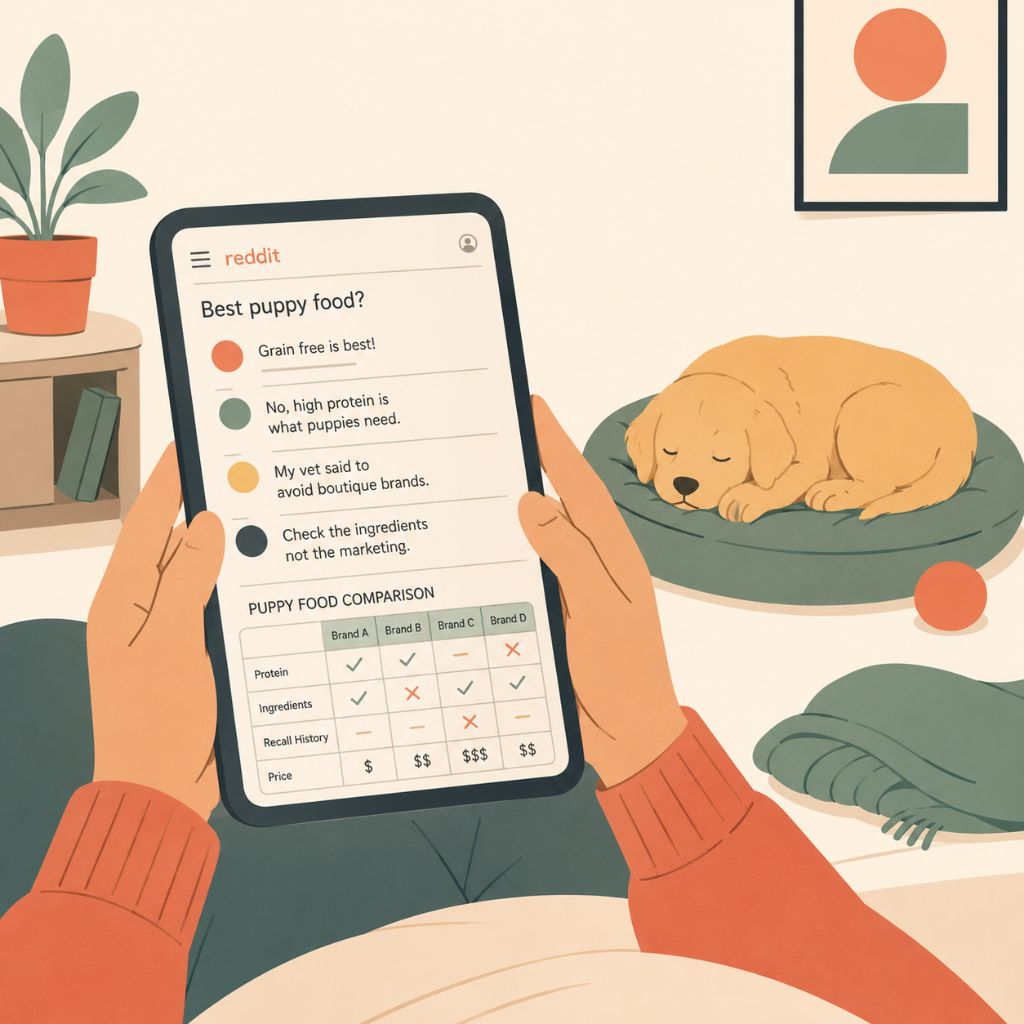
There was a tab for “best puppy food large breed.” A Reddit thread with seventy replies, forty of which disagreed with each other. A chart comparing crude protein percentages I didn’t actually understand.
A vet’s Instagram post with three thousand comments, half of them insisting a completely different brand was “the only one that matters.” I’d opened and closed the same comparison chart four times because I kept forgetting which column meant what.
At some point I put my phone down and looked over at my puppy, asleep in the corner, completely unaware his dinner was the subject of a small nervous breakdown. I thought: he still has to eat tomorrow.
Three hours of research and I was no closer to a decision than when I’d started. That’s the moment I realized the tabs weren’t helping me find the right food. They were just letting me feel productive while I avoided picking one.
Why Every Bag Sounds the Same (and Every Review Contradicts the Last)
Here’s the part nobody warns you about going in: almost every bag on the shelf says some version of “vet recommended,” “made with real meat,” or “complete and balanced nutrition.” None of that is really a lie, it’s just not a differentiator.
It’s the bare minimum a food needs to say to get on the shelf at all. Reading 10 bags side by side like that gives you nothing to actually choose between.
So you go looking for reviews to break the tie, and the reviews contradict each other almost on purpose. One thread swears a brand caused loose stools. Another swears the exact same brand fixed their dog’s loose stools.
Like you always hear someone says grain-free is dangerous; someone else says grain-inclusive is outdated.
Eventually you realize a lot of these “reviews” are just one dog’s individual reaction, generalized into a universal rule, and there’s no way to know ahead of time which part of your puppy will turn out to be.
That’s the trap. The harder you research trying to find one objectively correct answer, the more conflicting data you collect, and the less capable you feel of deciding, even though you technically know more than when you started.
What We Actually Landed On
After three nights of this, I stopped trying to find the “best” food in some abstract, universal sense, and started asking a much smaller question: what does a food actually need to do for a puppy in his first year, and which formula checks every one of those boxes without requiring me to become an amateur nutritionist first?
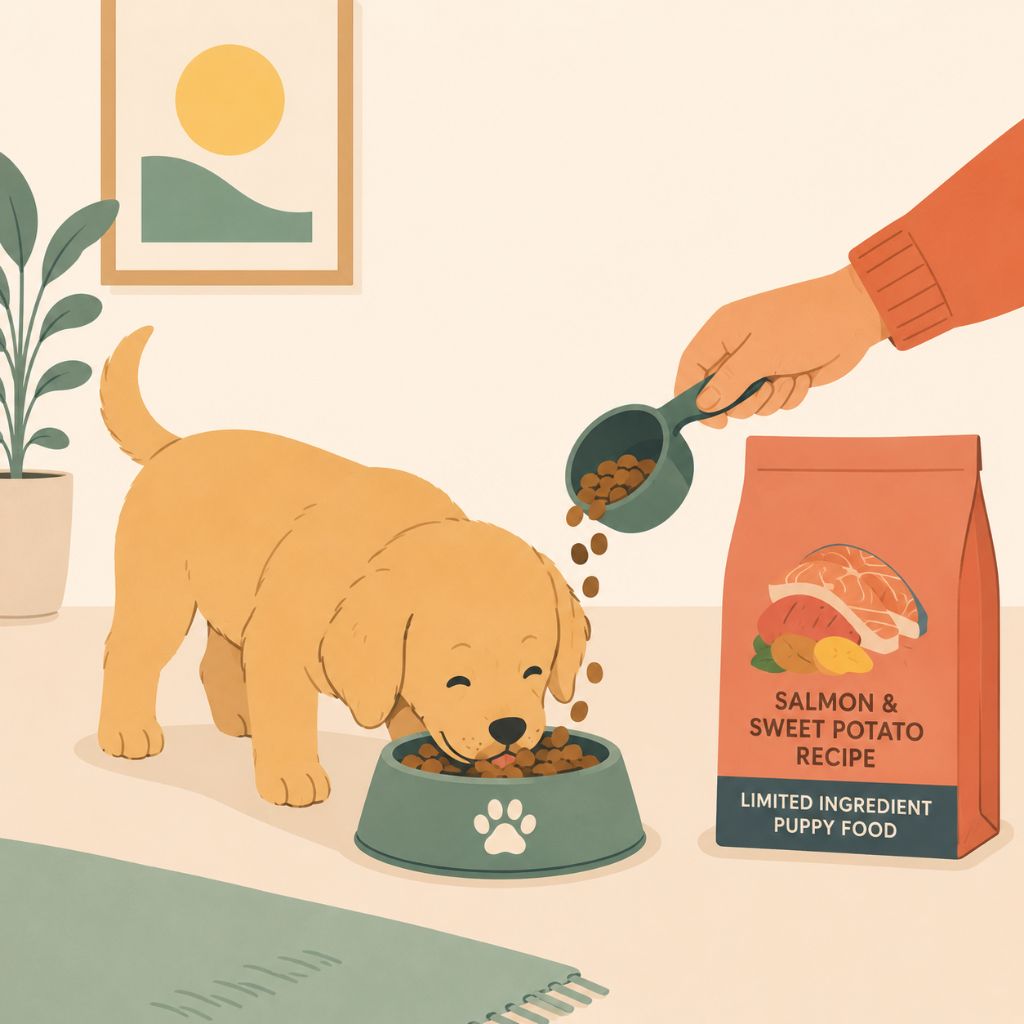
We landed on a limited-ingredient, salmon and sweet potato puppy formula food. Not because it won some ingredient arms race, but for three specific reasons that finally cut through the noise:
- A single named animal protein leads the ingredient list. No vague “meat meal” language. That mattered because it made it easy to rule an allergy in or out later if one came up.
- It’s formulated specifically for puppies, not an all-life-stages food, so the calcium and phosphorus ratios were actually built for a growing dog, not a generic average across every age.
- It kept showing up in three completely unrelated corners of the internet: a vet tech’s personal Instagram, a breeder’s puppy-pack recommendation list, and an unrelated Reddit thread. When three sources with nothing to do with each other land on the same answer, that’s a stronger signal than any single five-star review.
We started him on it with a slow, seven-day transition, mixed in with his old food. His stools firmed up by day four. That was the real proof, not the marketing on the bag.
The Tools That Made It Actually Work
Picking the food was half the battle. Not messing up the transition or the storage was the other half.
A slow transition matters more than people expect. Switching cold turkey is one of the most common reasons puppies get an upset stomach, and owners end up blaming the new food for a problem the switch itself caused.
We used a simple feeding guide and portion calculator that adjusts recommended amounts by current weight and expected adult size, since the chart on the back of the bag is a rough average at best, and our puppy is not an average puppy.
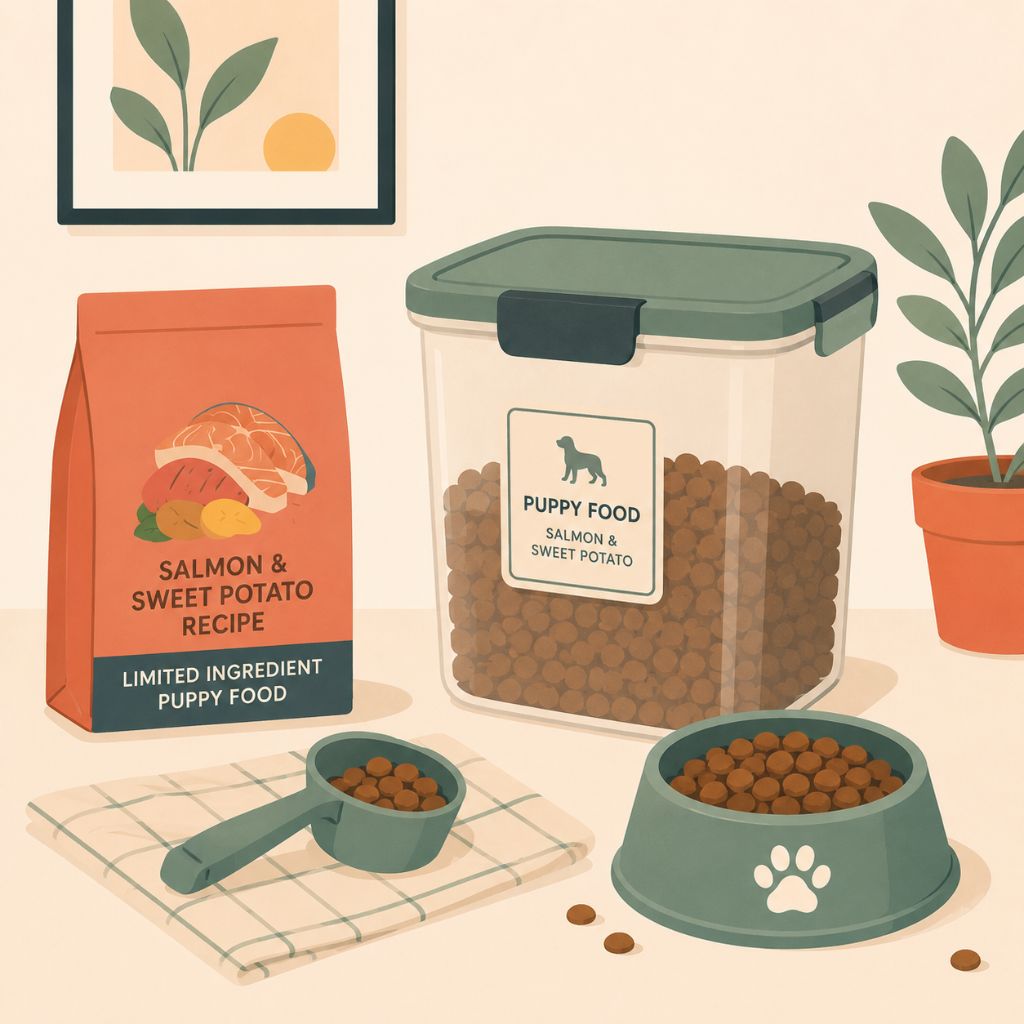
When it comes to storage, kibble left in a paper bag with a chip clip loses freshness fast, and larger bags (the ones that actually save you money) are especially prone to going stale or attracting pests.
But the airtight puppy food storage container keeps everything fresh and made scooping consistent portions really simple, instead of eyeballing it every meal.
What Other Exhausted First-Time Owners Finally Landed On
I mentioned the tab spiral in r/puppy101, half expecting no one to relate, and instead got a flood of people describing the exact same 1am research hole. A few patterns kept showing up in the replies.
Almost everyone who broke the cycle did it the same way: they stopped chasing the theoretically perfect food, picked one that met a short list of non-negotiables, and then judged it by how their actual dog responded over a week, not by another comparison chart.
One person said they kept switching foods every time a new review scared them, and their puppy’s stomach never got the chance to adjust to anything, which made every food look “bad” when the real problem was the constant switching.
Another said the moment they stopped reading forums and started reading only the ingredient panel and the puppy-specific formulation label, the decision took ten minutes instead of ten days.
A Simple Decision Checklist If You’re Still Stuck in the Tabs
Close every tab except this one and run through these five questions:
- Does the first ingredient name a specific animal protein, instead of a vague “meat” or “meal” blend?
- Is it formulated for puppies specifically, not a generic all-life-stages product?
- Does it show up consistently across two or three unrelated sources, not just one glowing review?
- Can you commit to a slow, seven-day transition instead of switching again at the first sign of anything unusual?
- Are you choosing based on what your puppy actually does on it for a week, not on how many tabs you currently have open?
If a food passes those five, stop researching and start feeding. You can always adjust later based on how your specific dog does, but you can’t get back the days spent stuck in comparison mode while your puppy still needs dinner tonight.

You Don’t Need the Perfect Answer, You Need a Good One Today
If you’re still sitting in a pile of open tabs, feeling like there’s one correct answer buried in there somewhere if you just keep searching, I promise you, there isn’t.
There are a lot of much better options and an enormous amount of noise sitting on top of them, and it’s the noise that’s exhausting you, not the actual decision.
You’re not failing your puppy by picking a good, well-reviewed, appropriately formulated food instead of hunting for the mythical perfect one.
The dog that ends up thriving is usually the one whose owner picked something reasonable and stuck with it long enough to see how he responded, not the one whose owner researched the longest.
Close the tabs. Your puppy still needs to eat tonight.