
This post contains affiliate links, see our full disclosure below.
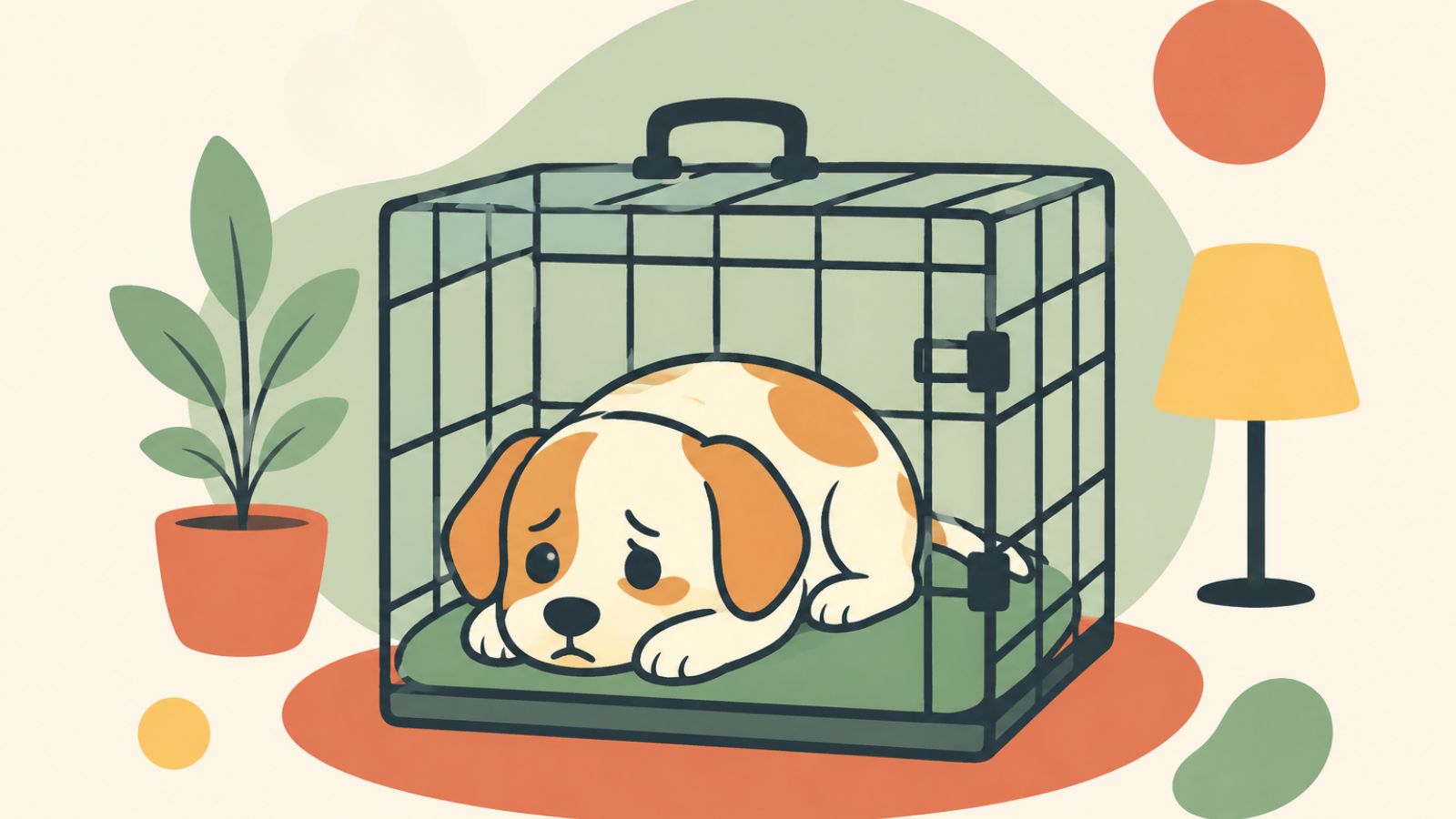
Puppy crying in crate at night was the exact phrase I typed into Google at 2am, standing in my hallway in a t-shirt I’d slept in three nights ago, staring at a crate that was losing this battle.
Your puppy has been crying for 40 minutes. You’ve tried the blanket over the top. You’ve tried the white noise machine. You’ve tried whisper-yelling “it’s okay, it’s okay” through the wire door like that’s going to fix anything.
You start Googling “why does my puppy cry in crate every night” at 2am with the brightness turned all the way down so you don’t wake up your partner, who is somehow still asleep through this entire thing.
Here’s what nobody tells you before you bring a puppy home: the crying isn’t always separation anxiety. It isn’t always “they just need to get used to it.” Sometimes the crate you grabbed off the shelf at the pet store, the one that looked fine, the one the employee said was “a good starter size,” is actually the problem.
Not you. Not even really the puppy. The crate.
I didn’t figure this out until night six. I kept thinking I was doing something wrong, some parenting failure I hadn’t identified yet. Then I actually got down on the floor and looked at the setup from my puppy’s eye level, and it clicked.
The crate was too big for a puppy that small, sitting in a hallway with foot traffic all night, with a blanket draped over it that blocked airflow and made it feel more like a box than a den. Three mistakes stacked on top of each other, and I’d made every single one without knowing it.
If you’re in the thick of it right now, keep reading before you rebuy anything. Most of this is fixable tonight, for free, with stuff you already have. The rest is a five minute swap, not a whole new setup.
The Signs Your Crate Is Actually the Problem
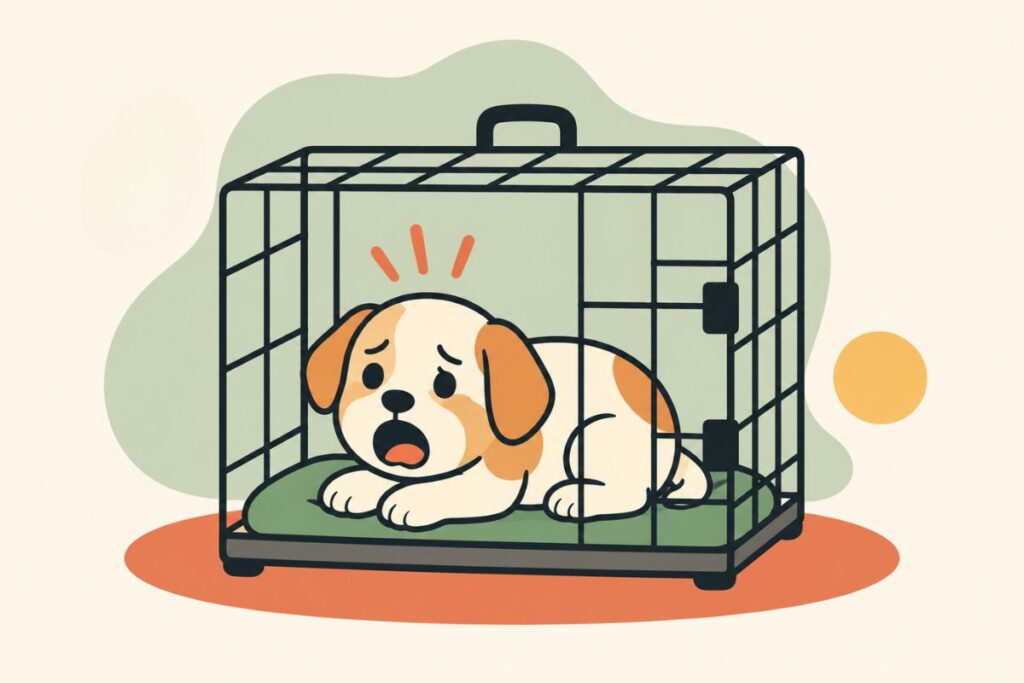
This is the part that gets skipped in every generic crate training guide. They tell you to “make the crate a positive space” without ever mentioning that the crate itself might be working against you. Here’s what to actually check.
Sign 1: the crate is too big.
If your puppy has enough room to sleep in one corner and use the other corner as a bathroom, the crate is too big. This is the single most common mistake first time owners make because bigger feels safer to us. It is not safer to them.
Dogs are den animals. A crate that’s too roomy doesn’t feel secure, it feels exposed, and a puppy that feels exposed does not settle.
You’ll notice this if your puppy is pacing in circles instead of curling up, or if you’re finding accidents in the crate even though they’re fully capable of holding it during the day.
Sign 2: the crate is in the wrong spot.
A crate in a busy hallway, near a window with streetlights, or too far from you (especially in week one) will keep a puppy in a low grade state of alert all night. They’re not crying because they hate the crate. They’re crying because their nervous system hasn’t clocked it as safe yet, and every footstep or headlight through the window resets the clock.
Sign 3: the setup is actively uncomfortable.
Wire crates with a bare metal tray. No warmth. No scent of you anywhere near it. A blanket thrown over the top that blocks airflow and turns a den into a stuffy box. Puppies will absolutely cry over physical discomfort even if the size and location are right.
Sign 4: the crate has become associated with abandonment.
If your puppy only goes in the crate when you leave the house or go to bed, the crate has started to mean “the humans are gone now.” This one takes the longest to undo and it’s the one that turns into long term crate fear if it’s not caught early.
If you read those four and felt a little sick, that’s normal. That’s the moment I had too. It’s not a character flaw. It’s genuinely not obvious until someone spells it out, and most people spell out “get a crate” without ever explaining that not all crates and setups are created equal for a specific puppy in a specific home.
The Fix for Each One (Not a Generic “Try This”)
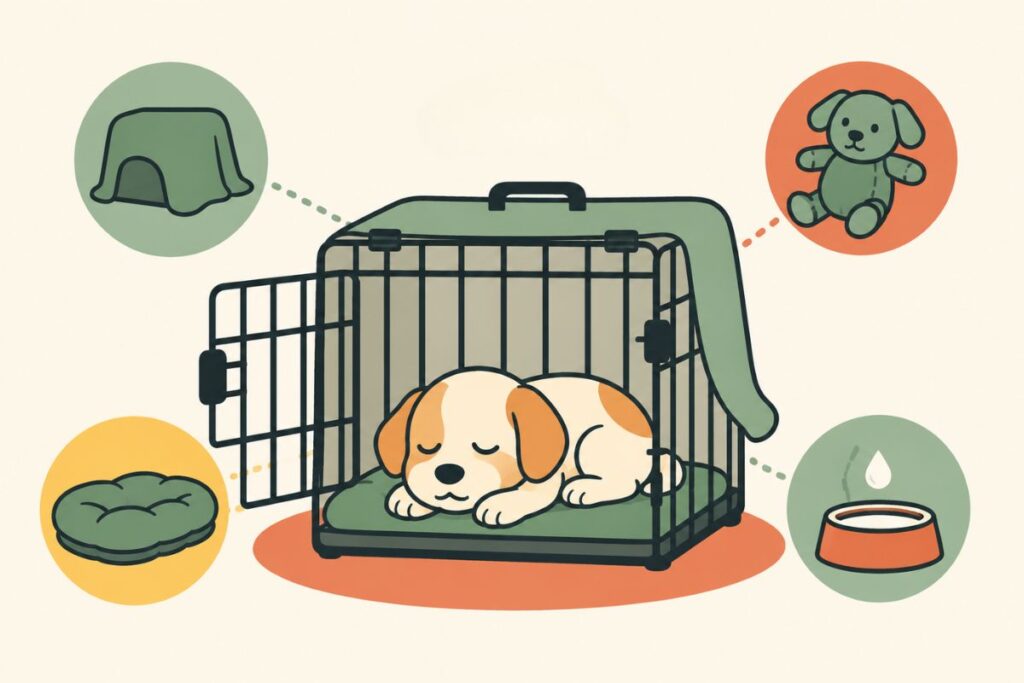
Here’s where most articles wave their hands and say “just get a smaller crate” or “just move it closer.” That’s not specific enough to actually fix anything at midnight. Here’s the exact swap for each sign above.
If the crate is too big: don’t buy a whole new crate yet. Most crates, especially the ones marketed for “growth,” come with a divider panel. If yours didn’t include one, this is the single highest impact five dollar fix you can make tonight.
A divider panel cuts the crate down enough room to stand, turn around, and lie down, nothing more. If your crate didn’t come with one and doesn’t have mounting slots for one, that’s when it’s time to size down.
A properly sized crate for a puppy under 25 lbs with a divider already built in will save you from buying two or three crates as they grow, since most of these are designed to expand with your dog.
If the crate is in the wrong spot: move it into your bedroom for the first two to four weeks, even if the long term plan is the kitchen or living room. Right next to your bed, close enough that your puppy can hear you breathing and smell you without seeing constant motion.
Once they’re consistently sleeping through the night in your room, you can migrate the crate a little further every few nights. If your bedroom doesn’t have room, a compact crate built for tight spaces solves this without you having to rearrange furniture at 11pm.
If the setup is uncomfortable: skip the blanket over the top, it blocks airflow and can actually raise anxiety instead of lowering it. Instead, use a crate cover designed with mesh venting that blocks visual stimulation without cutting off air.
Underneath, swap the bare tray for a chew resistant crate pad that actually holds your scent after a night or two, which does more heavy lifting for “feels safe” than almost anything else on this list.
If the crate has become associated with abandonment: start feeding meals in the crate with the door open during the day, no exceptions, for at least a week. Toss a stuffed food toy in there a few times a day when you’re home and present. The goal is for the crate to mean “good things happen here” way more often than it means “I’m alone now.”
What Other First Time Owners Got Wrong Before They Figured This Out
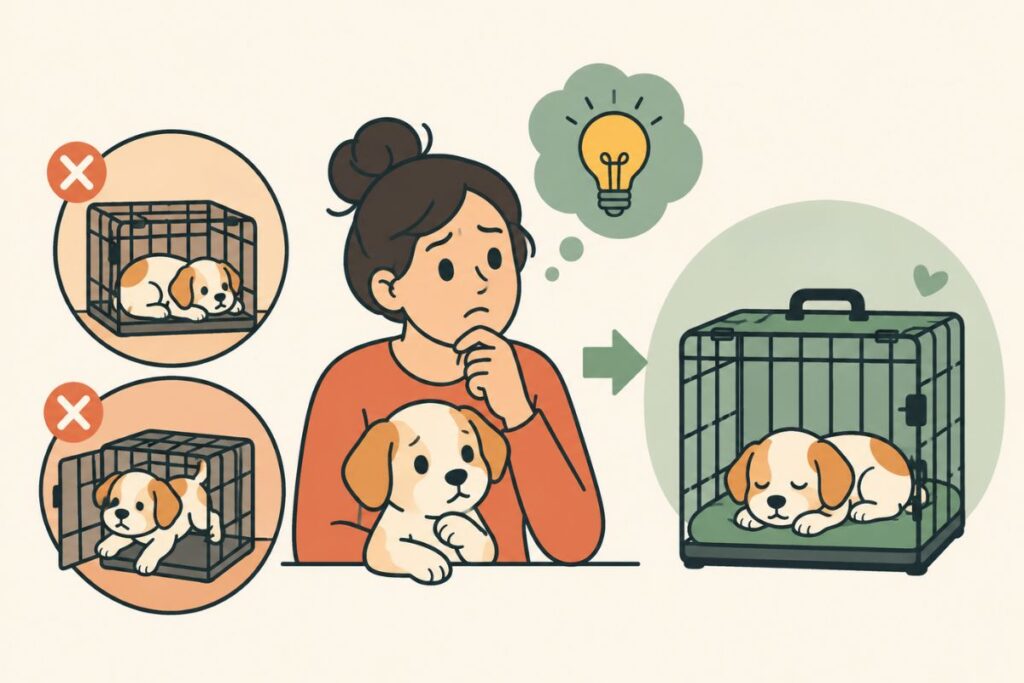
I posted about this in r/puppy101 after our third rough night and the replies were honestly a relief. One person had the exact right size crate but had it positioned right under an air vent that kicked on every 20 minutes.
Another had done everything right except they’d bought a crate meant for an adult dog “so we wouldn’t have to rebuy later,” not realizing the extra space was actively working against training in week one.
A third person realized their crate cover was actually a heavy moving blanket that trapped heat and made the whole thing stuffy.
The pattern across almost every comment was the same. Nobody thought the crate itself could be the wrong piece of the puzzle. Everyone assumed they’d eventually just “get through it.” A lot of people didn’t need to get through anything. They needed a five dollar divider or a two foot move across the room.
Quick Win Checklist to Test Tonight, Before You Buy Anything
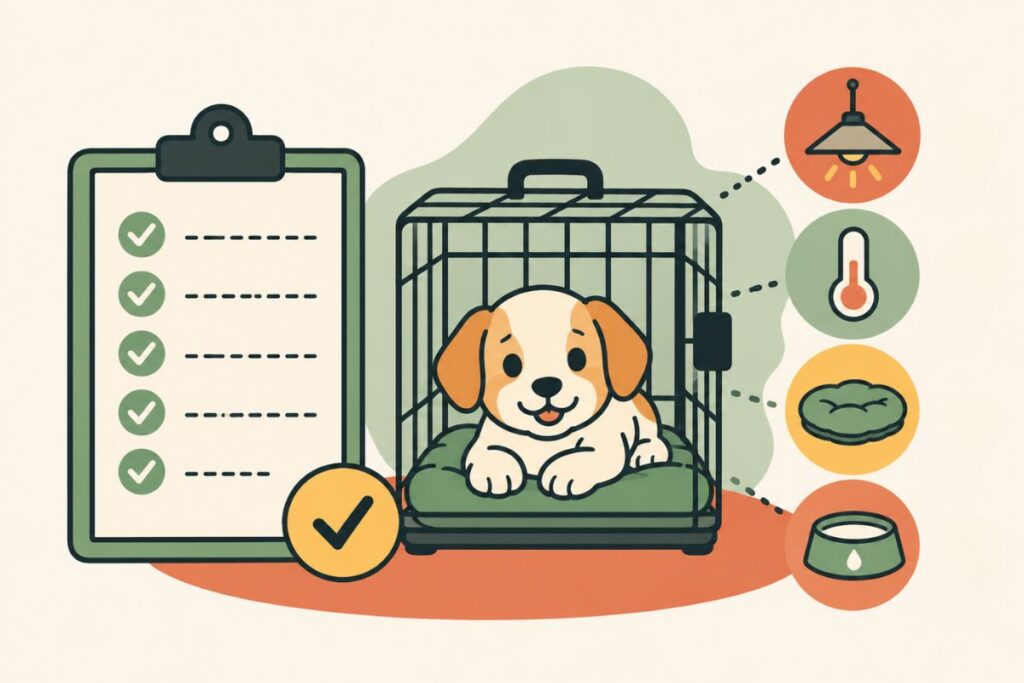
Before you spend another cent, try these tonight. All of them are free and take less than ten minutes combined.
- Stand at the crate and check if your puppy can fully stretch out lying on their side. If there’s noticeably extra space beyond that, it’s too big for now.
- Move the crate as close to where you sleep as physically possible tonight, even just for temporarily.
- Remove any thick blanket covering the crate and swap it for a light towel that still lets air through.
- Rub a t-shirt you’ve worn against the crate bedding so it smells like you.
- Feed the next meal in the crate with the door open, and don’t close the door for anything other than sleep tonight.
If you make these five changes and tonight is noticeably better, you’ve confirmed it was a setup issue, not a “your puppy just cries” issue. That’s when you go back through the fixes above and pick the specific product that matches the specific sign you caught.
You Didn’t Break Your Puppy
If you’ve made it this far feeling guilty, stop. A crying puppy in a crate that’s too big, in the wrong spot, without the right setup, is not a sign you failed at this. It’s a sign you were handed a “one size fits all” product for something that was never one size fits all to begin with.
The good news is this is one of the most fixable problems in the entire first 90 days. It’s not a training issue that takes weeks to undo. Most of the time it’s a five minute swap and one or two nights of consistency before things settle.
You caught it. That’s the hard part. The rest is just picking the right piece for the sign you’re seeing and giving it a few nights to work.
Your puppy isn’t broken. The crate setup was. Now you know which one to fix.
If you’re not sure what size crate you should even be starting with based on your puppy’s breed and expected adult weight, we broke that down separately in our puppy crate size chart by breed and age so you’re not guessing at the sizing step either.
Frequently Asked Questions
How long is it normal for a puppy to cry in a crate at night?
Some crying in the first few nights is normal as a puppy adjusts. If crying continues past two weeks with no improvement, or gets worse instead of better, it’s usually a sign of a setup issue like size, placement, or comfort rather than something that will resolve with time alone.
Should I let my puppy cry it out in the crate?
Letting a puppy cry it out without checking the setup first can reinforce the crate as a negative space, especially in the first few weeks. Check size, placement, and comfort before deciding to wait it out.
What size crate does a puppy actually need?
A crate should only be big enough for a puppy to stand, turn around, and lie down flat. Extra space beyond that usually needs a divider panel, since too much room can make a puppy feel less secure rather than more comfortable.
Where should a puppy crate go at night?
For the first two to four weeks, a puppy crate is best placed close to where you sleep, ideally in your bedroom, so your puppy can hear and smell you without added noise or light disturbance from other parts of the house.
Affiliate Disclosure: Puppy Panic is reader supported. Some links in this article are affiliate links, which means we may earn a commission if you make a purchase, at no extra cost to you. We only recommend products we’ve genuinely used or would use ourselves. This helps keep the site running and doesn’t affect the price you pay.